
As brands strive for packaging that attracts attention while meeting environmental goals, special effects inks and coatings are now being developed to align with sustainable practices, writes Taylor Sinclair.
In a market where consumers often make split-second buying decisions at retail shelves, physical packaging remains one of the most direct and powerful touchpoints between brand and consumer. Within this context, the power of visual and tactile effects on the packaging has arguably never been more impactful. Metallic flashes, soft-touch varnishes, and light-reactive coatings no longer belong exclusively to luxury brands – they have entered the mainstream flexo arena.
Lindsey Macfarlane, product development at Antonine Printing Inks, observes that “brands are increasingly using packaging as a visual and sensory statement by incorporating a variety of special effects that enhance appeal and engagement”.
She highlights the use of metallic inks in silver, gold, or custom formulations designed to deliver high reflectivity; thermochromics, temperature-activated inks that change colour, either reversibly or irreversibly, adding an interactive element to the packaging; UV fluorescent inks that remain transparent under visible light but fluoresce under UV illumination; and tactile coatings that create distinctive surface textures – ranging from smooth and velvety to coarse and rough.
Sun Chemical’s functional coatings product manager for EMEA, Michel Vanhems, highlights how metallic effects remain the most popular choice in the effects category, accounting for around 80% of demand.
He adds that tactile coatings are also in high demand. “The ‘paper-feel’ finish applied to plastic packaging gives a natural, textured surface that conveys authenticity and quality, while glossy coatings on board remain popular for creating contrast and visual depth,” he states.

“Brands want special effects that are achievable inline, within standard flexo printing, rather than requiring separate finishing steps.” – Dr Lutz Frischmann, hubergroup
Druckfarben’s laboratory manager Vanessa Panagiotopoulou observes that while brands continue to use these innovations to enhance shelf appeal, there is also a clear shift toward simpler, cleaner aesthetics – a design approach that goes hand in hand with the increasingly sustainable nature of the inks.
“Brands are moving away from multi-layer complexity in favour of clean lines, soft-touch finishes, and transparent effects that emphasise purity and sustainability,” she says. “We also see a rise in the use of special tactile finishes such as soft matte or textured varnishes especially in premium food and personal care segments.”
Eco-elegance
Ms Panagiotopoulou’s words take us towards the key factor at play in the ongoing development of special effects inks and coatings: that while brands continue to chase ever more creative packaging, it is sustainability that has become the defining measure of innovation.
In short, consumers now demand a balance between beauty and sustainability: they want packaging that dazzles but does not do so at the cost of damaging the planet.
Antonine’s Lindsey Macfarlane says: “Consumers are increasingly seeking packaging that combines visual appeal with environmental responsibility. In response, Antonine Printing Inks continues to work with brands to integrate special effect inks and coatings into flexible packaging formats that are recyclable, compostable, or made from renewable resources. These effects allow brands to deliver premium aesthetics and customisation opportunities without compromising sustainability goals.”
Similarly, Dr Lutz Frischmann, global product director for flexible packaging at hubergroup, emphasised the company’s dedication to sustainability, stating that it follows a “Design for Recycling” approach, which ensures all its inks and coatings support recycling or deinking.
“By combining creative functionality with responsible chemistry, we help customers reduce environmental impact while achieving striking visual and tactile effects,” he said.
Describing sustainability as a core focus of its innovation, Druckfarben’s Vanessa Panagiotopoulou, says its current developments include PVC and NC (nitrocellulose) free. These include its PUX ink, a mid performance flexo ink system built on the company’s advanced PU (polyurethane) base, designed specifically for converters who seek a balance between performance, cost efficiency, and environmental compliance. She adds that this ink is optimised for mono-material substrates like PP and PE that are designed for mechanical recycling.
Ms Panagiotopoulou adds that the company’s effects inks comply with guidelines such as those set by CEFLEX, the European consortium working to make flexible packaging circular, keeping ink weight percentages within thresholds that do not interfere with recyclability (typically under 5% of total packaging weight). At the same time, the company works to reduce VOCs (volatile organic compounds), enable faster drying at lower temperatures, and maintain high pigment concentration, to minimise overall ink consumption while still delivering standout aesthetics.
Sun Chemical’s approach towards sustainable special effects and coating inks is to dive into the inks chemistry as it transitions to NC alternative ink systems following evidence that NC-based inks can negatively affect recyclability.
“Brands are moving away from multi-layer complexity in favour of clean lines, soft-touch finishes, and transparent effects that emphasise purity and sustainability.” – Vanessa Panagiotopoulou, Druckfarben
Michel Vanhems comments: “By removing or reducing NC from formulations, Sun Chemical supports upcoming European regulations that require inks to be non-detrimental to recycling processes.
“Sun Chemical’s strategy is to develop products that go ‘beyond compliance’, meaning the minimisation or elimination of substances of concern.”
Flexo compatibility
Of course, sustainability within this topic is vital, but for flexo printers, an ink/coating which is suitable for their set-up is also crucial.
Mr Vanhems says flexo remains a major focus area for Sun Chemical’s development efforts with the company offering energy curable, solvent based and water-based systems, giving converters flexibility to choose the most suitable solution for their operation and sustainability targets.
Through Sun Chemical’s SunInspire range, NC-alternative technologies, and advanced metallic and tactile coatings, the company can support its customers by providing flexo printers with a complete toolbox of “reliable, creative and compliant” solutions.
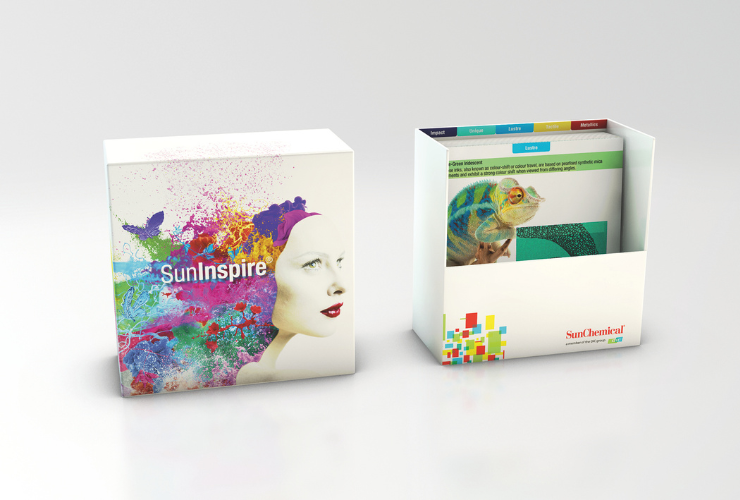
Sun Chemical’s SunInspire offers tactile, metallic, pearlescent, and matte finishes
Dr Frischmann of hubergroup confirms the view that flexo printers want inks and coatings which fit within their current structure, saying: “Brands want special effects that are achievable inline, within standard flexo printing, rather than requiring separate f inishing steps.”
With this in mind, hubergroup’s product solutions include its solvent based Gecko Xperience varnishes for gravure and flexographic printing, which gives packaging a soft or paper like feel. Also highlighted is its most recent innovation, Iriflow – a patented multilayer technology that creates fascinating colour-changing effects – so-called colour flops – without costly interference pigments.
Creativity with a conscience
Sustainability is clearly a central theme in special effects inks and coatings, as it is in so many other areas that affect the flexo sector. Advances in special effects inks and coatings now put recyclability at the forefront of design, proving that innovation and environmental responsibility can coexist. Today, beauty and responsibility are not opposites; they are partners.
And like all successful partnerships, the synergy between the two is only likely to grow and grow in the flexo sector as it looks to adapt and become more innovative. Balancing creative ambition with sustainability is no longer an aspiration – it is the expectation.