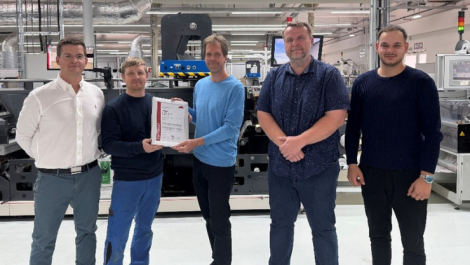
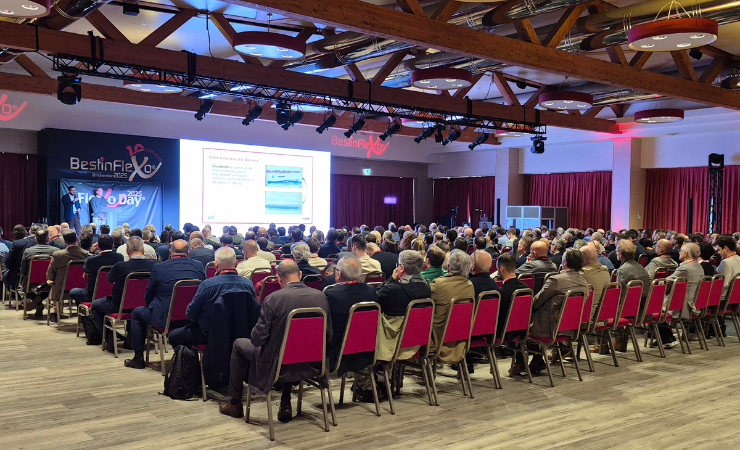
Italian flexo association, the ATIF, held its annual conference and awards in Milan in late November. FlexoTech editor Andy Knaggs was invited along to enjoy the technical presentations.
Barrier coatings, nitrocellulose free inks and colour proofing were among the technical discussion points as the Italian flexo association, the ATIF, held its Best in Flexo conference in Milan in November.
FlexoTech magazine was present only on the second day of the two day event, which had the association’s annual awards sandwiched on the evening between. Welcoming attendees to Day Two was ATIF president Andrea Dallavalle, who highlighted the “perfect storm” that packaging faces, with pressures from sustainability demands, from consumer factors such as transparency, personalisation and product security, and from evolving technologies such as the Internet of Things, smart and connected packaging and Generative AI.
However, Mr Dallavalle added that flexo printing’s ability to process a range of different substrate and ink types meant that it could retain a strong position in the market, while helping the sector in its transition from multi material to mono-material packaging structures and the migration from plastic to paper-based materials.
The conference went on to feature presentations from members of ATIF technical committees, as well as from partnering manufacturers from the industry.
Coating to proofing
The first technical committee session featured a discussion on barrier coatings by Matteo Bettinelli and Jean-Michel Santarella. They talked about how different barrier coatings are developed for different potential types of contaminants, such as grease, moisture and oxygen, and how there were three key things to focus on: the substrate material; the quality of the coating; and the technique used to apply it.
What issues might be encountered with flexo machines, the committee members asked. First, the thickness of the coating, which might be limited by the anilox; next, the need to dry the packaging, which might mean slowing down the machine, resulting in profitability issues. “It is very important to accurately specify the barrier characteristics – correct coating, correct paper, because the wrong paper will make it impossible to get the required barrier standards,” they said.
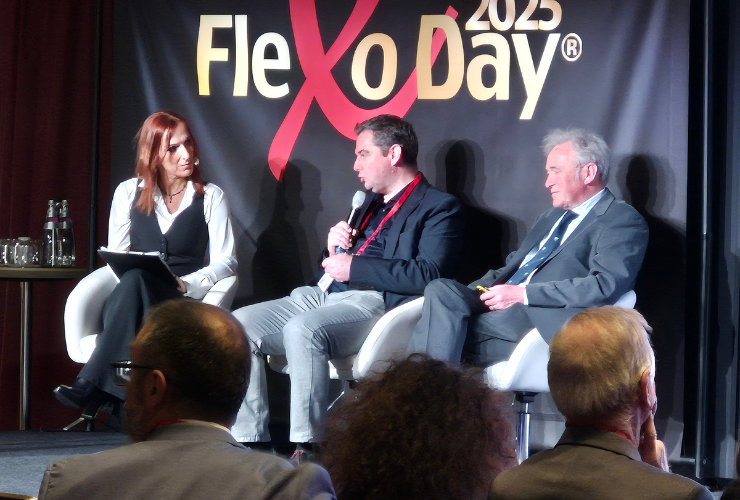
FTA Europe’s Kristof Lobeau speaks, while Professor Claypole and moderator Chiara Bezzi listen
Colour proofing was treated to an entertaining three-man presentation from ATIF technical committee members Fabio Casavecchia, Francesco Costanzo and Stefano d’Andrea. The punch line came at the end, when the presenters drew attention to the length of time that has passed since the development of the Fogra 39 colour profile – meant for offset, but at times used even in the flexo sector it seems to base a colour profile upon.
“We need to characterise the printing machine, which means knowing everything about that machine, and we have to customise the colour proof for each machine,” the presenters said. “Fogra 39 was developed in 2004 – does it make sense to use that now? It is also for offset, so what’s the advantage in using it for flexo? In flexo, each output, each printing machine, has different features so, in consequence, in flexo we should never, ever use a Fogra 39 press proof, without making the necessary changes.”
The third and final ATIF Technical Committee session was delivered by Fabio Cavazzi of Sun Chemical and Francesco Talamonti of Flint Group, under the title “Impact of inks on packaging recycling”. In the presentation, several issues that ink manufacturers are wrestling with were discussed – aspects that present difficulties in balancing quality and sustainability in product development.
Among those mentioned was a red pigment, PR53:1, that has been removed as a viable ingredient in the soon-to-arrive German Printing Ink Ordinance (GIO) due to having been found to be carcinogenic. The GIO also limits the migration of photo-initiators, meaning difficulties in the development of UV inks.
The use and regulation of biocides to prevent bacterial proliferation in water-based inks was explained, while limits on the use of PFAS (per- and polyfluoroalkyl substances) by the EU are causing ink manufacturers to look at replacements for these synthetic chemicals, which amongst other things increase resistance to scratching.
Copper is another issue, as is Pigment Black 7, which uses carbon black to deliver a deep black. In the case of the former, it is much used in blues but its weight could be problematic in an environment where the ink weight as a proportion of total pack weight is important. Using alternatives delivers a different hue of blue. The issue with Pigment Black 7 is that recycling systems struggle to recognise material with more than 50% black printed coverage. Again, alternative pigments can be used instead of carbon black, but the black ink produced is noticeably less black, leading to the question: will marketers accept that black?
Partner platform
Interspersed with the technical committee sessions were presentations from partners of the event – specifically, Uteco, Sun Chemical and Bobst.
From Uteco, head of product marketing Mattia Carpinetti talked about “paperization” and a new barrier coating in development. He also revealed that the company has been working on a new tool for measuring the carbon footprint of a flexo press.
The context for it all was that paper is the main material used for packaging in Italy and is also the most recycled. Complications with recycling for multi-material packaging are seeing the move to mono-material. Uteco has been working with inks and material suppliers on developing a paper based material and a barrier coating, applied using a CI flexo press and drying unit. He said that preliminary tests with a 75gsm paper stock had shown very good results with oil and grease resistance and permeability with humidity.
Uteco has been working with Italian machinery manufacturers association ACIMGA and standardisation body UNI to create the tool to measure the environmental impact of a flexographic printer, and this has been published by UNI under UNI/PdR 169: 2024 “Sustainability of flexographic central impression printing presses – Requirements and innovation indicators for printing processes”.
“It’s the first time something like that has ever been done,” said Mr Carpinetti. “The goal is to raise manufacturer awareness on something that’s not been measured quantitatively. This tool might allow us to do that.”
Later in the schedule there was an interesting presentation by Antonella Benzi of Sun Chemical about nitrocellulose (NC) and its use in flexo printing inks. It has been quite well documented – including in the pages of FlexoTech – that NC poses problems in recycling and is also in great demand by the armaments industry as a key component in certain military weaponry. NC is known by another name: guncotton.
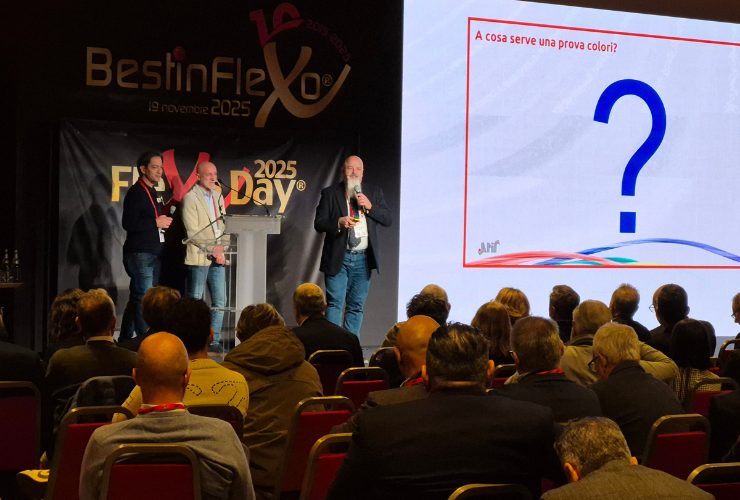
The colour proofing session provokes thoughts
These situations have caused ink manufacturers to have a rethink about alternatives. The solution has been PU (polyurethane) resins, but there has been a huge amount of laboratory testing work required on aspects such as adhesion, printing performance and solvent retention.
“We started with a problem, and the problem has now become an opportunity and a solution,” said Ms Benzi. “We have developed NC-free solutions that are sustainable and high performance, without carrying out industrial testing. In this stage, collaboration is paramount because we believe only together can we complete this process of NC to NC-free inks.”
Wrapping up
The final sessions of the ATIF Best in Flexo conference included a presentation by Emilio Alliegro from Bobst, discussing how the company is helping customers move to more sustainable digital processes, with great reference to the four pillars that Bobst commonly outlines: Automation, Sustainability, Digitalisation and Connectivity. “Sustainability is a competitive advantage for customers and is influencing the technological evolution of our machines,” he said.
Concluding, there was the presentation of a Best Student in Flexo 2025 award to teenager Giorgia Baldi, and a short panel session with FTA Europe’s Kristof Lobeau and Professor Tim Claypole, updating the audience about test forms for colour uniformity and bouncing/banding that are under development. There is more to be done, especially with the colour form, it seems, with Professor Claypole remarking wryly that “we have opened a can of worms and we will be working on this for some time”.