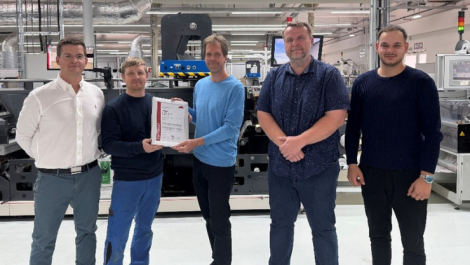
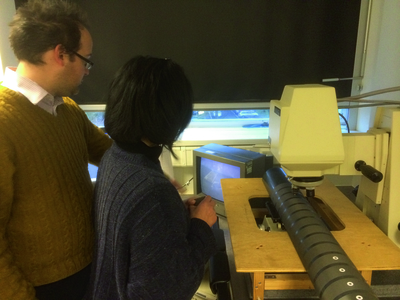
Dr Davide Deganello PhD and Sakulrat Foulston in the process of analysing the test banded anilox
With recent advances in technology and established mathematical models, it is now possible to prove accurate volumetric measurement for anilox rollers. This breakthrough is a direct result of considerable development by Troika Systems Limited and the WCPCat Swansea University, explains Troika managing director, Phil Hall.
The ability to manage anilox inventories by knowing the condition of each roller, and its suitability to go onto press, through consistent measurements and proven cleaning techniques, has significantly reduced ink and makeready waste for the majority of printer companies, which have adopted anilox inventory management processes, saving anything from £5,000 to over £10,000 per month. However, whilst the electronic measurement devices have proven themselves for consistency of readings and repeatability of measurements, typically ±0.1cm³/m² for the process anilox rollers, accuracy of measurement has been subjective up until now.
The accuracy of measurement has been a point of contention between the different anilox manufacturers, which rightfully defend their own historic (analogue) methods of measurements. As reported in a study in 2007, these methods showed significant variations in measured volumes (often over 50%). Therefore the need for accurate volumetric measurement was recognised and requested by printers who wanted a proven reference from which to measure inventory, and for ordering replacement aniloxes.
Accurate measurement
To prove accuracy, two questions need to be asked: How accurate does the measurement system need to be? and What reference should be used to qualify ‘accurate’?
Achieving the correct densities in process colours is the most costly part of press set up and it is therefore a good starting point. In various studies, it has been shown that process aniloxes engraved to within 0.4cm³/m², or better, of each other will achieve a colour accuracy of typically 3 delta E. So if the inventory is within 0.4cm³/m², the printer will achieve the desired colour target faster and minimise waste. Therefore a suitable target for the measurement instrument would be to have a repeatable accuracy of ±0.1cm³/m² for the range of process aniloxes, and of ±0.2cm³/m² for coarser screen counts.
With electronic scanning devices, it has been possible to prove volumetric accuracy, which has simply not been possible with the historic analogue (ink drawdown) systems. The ability to prove accuracy has been an evolutionary process and has become a practical solution since earlier this year, 2014.
The method of proving accuracy is through simple mathematics and ‘balls’.
If the diameter of an accurately ground sphere (ball bearing) is known, its X, Y and Z dimensions, its volume and surface area and any other parameters can be calculated through simple maths. Extrapolating that data makes it possible to calibrate the electronic scanning microscopes very accurately to within ±1 micron, and subsequently accurately define the volume of the sphere. Once the 3D scanning microscope (AniCAM) is calibrated to the sphere, the analysis program (Anilox QC application) will correctly measure the volumes of any anilox to be measured.
Proving the theory
In February this year, working in conjunction with the WCPC, Troika Systems undertook the project to test the depth and volumetric accuracy of a sphere-calibrated AniCAM against the WCPC high-end interferometer measurement system on a 12 banded anilox, engraved from 1,500 lpi down to 100 lpi. Both devices used different mathematical models to calculate the volumes on the test anilox.
The correlation of measurement between the two systems was exceptionally close. A report was compiled by Dr Davide Deganello PhD and Mrs Sakulrat Foulston, who took the measurements and computed the results.
Dr Deganello stated, ‘As there is a recognised inevitable variability of volume due to surface roughness, minor variations in measurement were expected. However, there is a very high degree of consistency between the two systems. The accuracy of the measurement systems is certainly well within the required measurement requirements of the industry.’
Conclusion
For printers, a standard of volumetric measurement has now been scientifically proven with a practical instrument that can be used on the shop floor. Printers and anilox manufacturers alike can now have the confidence that measurements are realistic and based on credible data, from which the industry can work from as a proven point of reference.
Will this development have any impact on the future of our industry? Almost certainly the ability to measure aniloxes accurately will allow printers to have a reference from which to work from and allow greater freedom when choosing between different suppliers and to check the quality and consistency of aniloxes purchased.
It is also anticipated that it will contribute to future developments in electronic printing and allow the ongoing development of ink release characteristics to be calculated from different engraving shapes and styles, and consequently the optimising of ink rheology for different cell structure.