New research from Smithers indicates that barrier coatings continue to dominate the global packaging coatings market, which is projected to be worth nearly $15.4 billion (£11.5 billion) in 2026.
The findings, published in the report, “The Future of Packaging Coatings to 2031”, also point to water-based and specialty coatings as the fastest-growing segments through 2031.
According to the study, barrier coatings accounted for demand of 4.4 million tonnes in 2025, representing a market value of $9.97 billion (£7.4 billion). Extrusion coatings currently make up the largest share of packaging coating volumes at 33.4%, with polyolefins comprising more than 63.5% of that category. However, water-based coatings and specialty vacuum deposition technologies are expected to experience the strongest growth over the next five years.
The report highlights the impact of European regulations on the sector, including the European Union’s Packaging and Packaging Waste Regulation (PPWR), which took effect in February 2025 and is scheduled for full implementation by July 2026, as well as the EU Single-Use Plastics Directive. These measures are expected to influence packaging requirements in Europe and support growth in sustainable packaging coatings across the region through 2031.
Robert Outram, a consultant at Smithers and co-author of the report, said coatings are becoming increasingly important in helping packaging formats meet recycling and circularity standards required by regulators and consumers. He added that innovation in coatings technology is playing a central role in developing alternatives to traditional packaging materials.
The study notes that solvent-based coatings, which have historically been widely used in applications such as flexible plastic films and aluminium foils, have been declining since 2023. In the primers segment, solvent-based technologies represented 51.3% of volume demand in 2025, while water-based systems accounted for 44.6%. Radiation-curable technologies were identified as the fastest-growing primer category.
Researchers also pointed to ongoing technical challenges associated with water-based and UV-curable systems, particularly regarding adhesion and drying performance on plastic substrates, compared with established solvent-based products.
Food packaging remains the largest end-use sector for packaging coatings, accounting for 2.74 million tonnes of demand in 2025, or 39.4% of the global market, valued at $5.89 billion (£4.4 billion). Beverage packaging represented a further 30.8% of demand, valued at $4.55 billion (£3.4 billion). Within the food category, savoury snacks and confectionery were identified as leading growth areas.
The pharmaceuticals and healthcare segment, while representing 4.5% of market volume in 2025, is forecast to record the fastest growth through 2031. The report attributes this to technical performance requirements and increasing interest in more sustainable pharmaceutical packaging solutions.
The shift by major fast-food chains toward paper fibre-based foodservice packaging is also contributing to increased demand for paper coatings that provide grease, moisture and heat resistance without fluorocarbon chemistry. Water-based acrylic barrier coatings were identified as a potential option for high-volume cup applications due to their compatibility with paper recycling systems.
Regionally, the Asia-Pacific market continues to lead global consumption of packaging coatings, supported by population growth, urbanisation and demand for packaged food and beverages. The report forecasts the fastest growth rates over the coming years in South America and Middle East and Africa, where packaging infrastructure and consumer markets are continuing to expand.
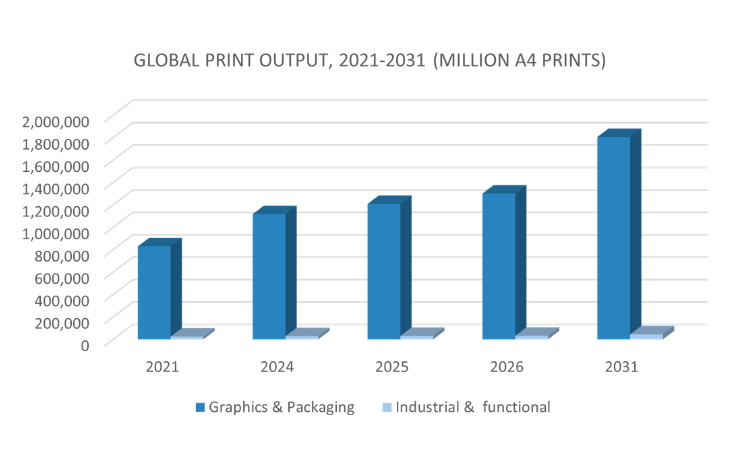
Smithers have also released another report, “The Future of Inkjet Printing to 2031”, which forecasts continued expansion for the global inkjet printing industry, with strong growth expected through to 2031 as packaging demand, sustainability pressures and advances in AI reshape the market.