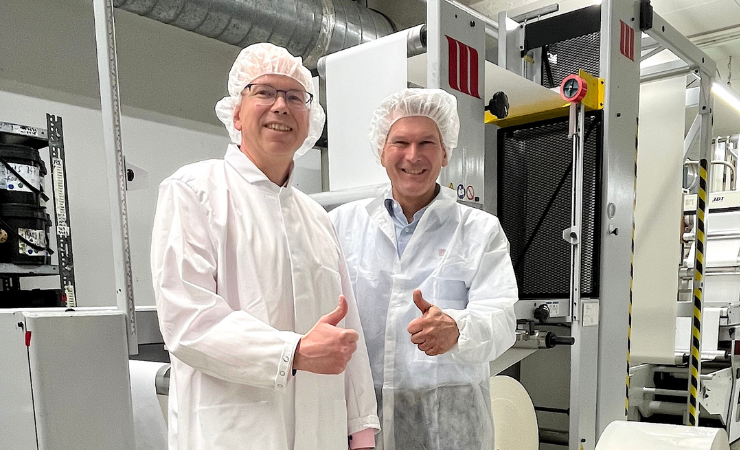
Label printer Römer Etikett has installed a Martin Automatic non-stop unwind and splice system featuring an overhead “bridge” web path on its Mark Andy press at its Marburg, Germany facility, enabling continuous operation on one of its flexo presses despite significant space and layout constraints.
The installation centres on a Martin Automatic MBS unwind/splicer configured to route the substrate above head height between the festoon and press infeed, creating a walkway beneath while maintaining continuous web tension. The arrangement was required due to the plant’s multi-level production floor and the limited space surrounding the press, which is positioned tightly between walls and structural pillars.
Bernd Schopferer, European sales manager at Martin Automatic, said the company was able to adapt its standard equipment to suit the site. “We knew exactly what Römer needed because we have fitted countless MBS models to label presses from all major manufacturers,” he said, adding that the challenge “was the site itself”, which required design adjustments to accommodate the unusual layout.
The Marburg facility, part of the Dublin-based Watershed Group since 2011, is built on a steep hillside, resulting in changes in floor level across the production area. To overcome this, the Martin Automatic’s system routes the web across a bridge above operator head height, allowing safe access beneath while providing the festoon capacity required for automatic splicing. Claus Schüring, general manager at Römer Etikett’s Marburg plant, said he was “very impressed” with the speed and smoothness of the installation given the restricted space.
The MBS system enables automatic roll changes at speeds of up to 150m/min and includes Martin’s EOPP splice-preparation guidance system, designed to reduce operator intervention. Mr Schopferer said the basic principle is automated roll changing without stopping the press, which saves time and allows more consistent production speeds, improving overall print quality and efficiency.
Since installing the splicer, Römer has begun using 4000-metre substrate rolls instead of the 2000-metre rolls previously run, while also making more effective use of partially used rolls. Mr Schüring said the vertically stored rolls are easier to handle and can be changed quickly despite their size and weight.
Early results indicate measurable productivity gains. Mr Schüring said the system is already saving “at least one hour per day”, with further improvements expected as additional automation across the press line is optimised. The Martin installation forms part of a €500,000 (£438,000) investment programme that also includes inspection systems, automated rewind technology and operator training.