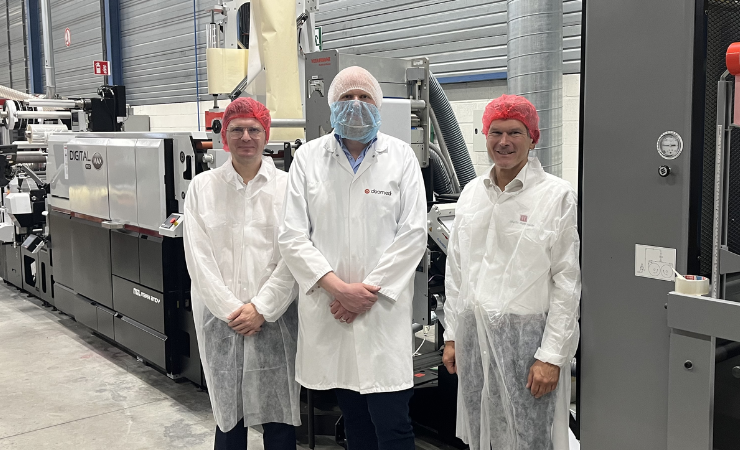
Belgian narrow web converter Desmedt Labels has become the “first in the world” to install a Mark Andy digital hybrid press fitted with Martin Automatic non-stop unwind/splice technology, according to Mark Andy.
When renewing its digital capacity, Desmedt selected the Digital Pro Max hybrid press from long-term partner Mark Andy. The system combines a toner-based digital engine with flexo converting units and supports a web width of 330mm, with production speeds between 20 and 40m/min depending on the job.
The configuration at Desmedt includes a web cleaner, corona treater, flexo stations before and after the five-colour digital engine, as well as laminating, die-cutting and slitting modules. The design allows further upgrades as production requirements evolve.
Mark Andy sales manager Timo Donati said the hybrid system was selected for its low cost-to-print and flexibility. He said the press offered short changeover times, inline finishing and strong print quality, making it a practical replacement for traditional roll-to-roll digital systems.
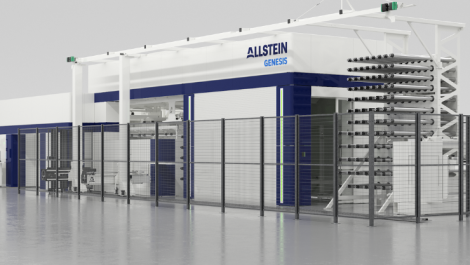
To support continuous production, Desmedt installed a Martin Automatic MBSC compact butt splicer. According to Bernd Schopferer, Martin Automatic’s sales manager, the system can handle two full 4000m rolls and is designed to match the production speed of the hybrid press, minimising web storage and material handling issues.
Henri Köhler, CEO of Desmedt, estimates that the combination of the Digital Pro Max and the MBSC splicer provides around one extra hour of production per shift. Operating three shifts per day, five days a week, this equates to roughly 750 additional production hours annually, the company stated.
Beyond time savings, Desmedt has also reduced material waste by maximising roll usage and enabling roll changes without stopping the press. This has improved overall yield and reduced scrap associated with manual changeovers.
“It’s not about speed, it’s about improving productivity by increasing uptime and reducing waste,” said Mr Köhler. He added that the industry often equates performance with running speed, overlooking the impact of automation on efficiency.
Automation has been part of Desmedt’s operations for more than a decade. In 2013, Mr Köhler set out to replace an ageing flexo press but instead revised the company’s wider investment strategy. This resulted in the installation of three Mark Andy Performance Series P7 flexo lines, each equipped with Martin Automatic non-stop unwind butt splicers. By 2024, two more P7 lines had been added.
As flexo technology improved in setup and changeover times, Desmedt began shifting short-run jobs back from digital to flexo. Mr Köhler noted that one of the latest P7 presses was installed specifically to handle short-run work that had previously been produced digitally.
The company, which was founded in 1889, currently employs 45 people and generates annual sales of approximately €15 million (£12.8 million). Mr Köhler plans further investments in automated flexo presses, continuing a strategy that prioritises productivity gains through technology rather than expansion in scale alone.