Polytag, Saica Flex and Paragon Inks have announced a strategic partnership to develop flexo printed UV-tagged packaging labels designed to provide brands with real-time environmental and recycling data.
The collaboration brings together Polytag’s detection technology, Saica Flex’s packaging production expertise and Paragon Inks’ specialist UV inks.
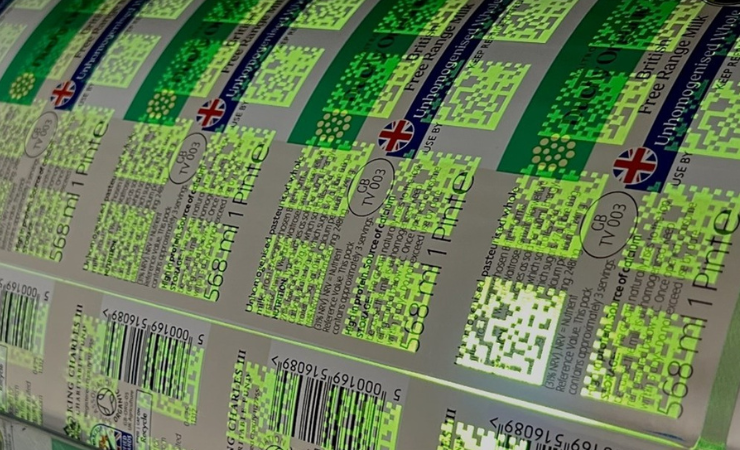
The first commercial application of the solution is already in market, with labels now appearing on Waitrose milk cartons. The partners said the labels are being detected in recycling facilities and are generating verified, item-level data on recycling performance.
The labels contain invisible UV tags printed with Paragon Inks’ products. When they enter the recycling stream, Polytag’s systems scan the labels and capture data that enables recyclers to track which products are recycled, measure recovery rates and demonstrate compliance with regulations such as Extended Producer Responsibility (EPR). This information can then be shared with brands to improve visibility of packaging performance.
The partners said the system has been designed to integrate into existing packaging and printing workflows without disrupting supply chains. Saica Flex’s close collaboration with Waitrose, combined with its experience in producing this type of packaging, enabled rapid deployment.
Francisco Barrera, sales and marketing director at Saica Flex, said: “We knew from the start that adoption would depend on keeping things simple. Brands need solutions that fit naturally into their operations and current production environments. This product works across the entire packaging lifecycle, from printing through recycling with minimal disruption. It gives brands meaningful insight, while remaining practical and viable even for high-volume products like milk cartons.”
Polytag’s CEO Alice Rackley added that because the system is built on GS1 global open standards, the UV tag solution is “ready to scale across multiple sectors and applications, allowing brands and recyclers to participate fully in building a transparent circular economy”.
The UV inks were developed to ensure full compatibility with standard waste management processes. The partners said the labels can be chipped down or separated through flotation, and any residual ink behaves in line with other approved UV products, ensuring recovered materials are not contaminated.
Barbara Paterson, technical director at Paragon Inks, said: “Creating the UV inks was a technical challenge. They needed to remain detectable by Polytag readers across a wide range of colours, substrates and packaging formats, even after packaging has been crushed or otherwise processed. At the same time, the inks had to meet strict food-safety and environmental requirements.”
The partners said early results from the Waitrose deployment demonstrate the system’s potential.