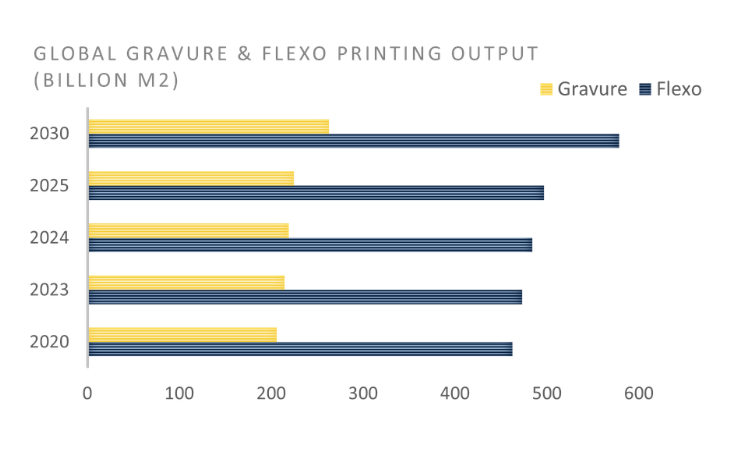
Data from Smithers newly published report, “The Future of Flexo vs Gravure to 2030”, reveals that flexo will be valued at $250.7 billion (£185.5 billion) in 2026. The segment is forecast to grow to $284.2 billion (£210.3 billion) by 2030, representing a compound annual growth rate (CAGR) of 3.2%.
Gravure printing, meanwhile, is valued at $107.8 billion (£79.8 billion) in 2026 and is projected to grow at a slightly faster rate of 3.6% CAGR to reach $124.7 billion (£92.3 billion) by 2030.
The total global market value for flexographic and gravure printing is set to reach $358.5 billion (£265 billion) in 2026, according to Smithers.
While flexo printing continues to gain market share wherever it competes directly with gravure, the report notes that gravure printing is expanding more rapidly in overall global volume. This growth is largely driven by its strong presence in rapidly expanding Asian packaging markets and industrial print sectors, the report highlighted.
The analysis, which covers applications across packaging, publication, labels, décor and functional printing, finds that gravure’s strength in high-growth Asian markets and decorative printing offsets flexo’s competitive gains in Europe and North America. In Asia, gravure has historically been the process of choice due to its superior reproduction of fine Kanji characters, although this advantage is narrowing as flexo quality improves.
Flexo remains the larger market globally in both value and volume and retains advantages in prepress flexibility and sustainability, states the report, due to modern flexo presses increasingly incorporating machine learning, robotics and AI-driven automation, helping to reduce waste, accelerate makeready and lower costs as run lengths shorten. The shift away from solvent-based inks and plates to water-based and UV-curable alternatives is also positioning flexo more favourably as environmental regulations tighten, said the report.
The report also highlights the continued decline of publication rotogravure as magazine and catalogue print runs contract. At the same time, both flexo and gravure are facing increasing competition from digital and hybrid inkjet technologies, particularly in labels and flexible packaging.
According to the study, flexo appears better positioned to meet evolving sustainability requirements, while gravure’s established installed base and strong presence in décor and industrial printing are expected to support its continued global relevance in the years ahead.